

Phuket climate in 30 seconds
- Climate
- Tropical, Andaman coast
- Warmest average high
- March: 34.4°C
- Drier period
- December to March
- Wettest months
- September and October
- Annual rainfall
- About 2,272 mm
- Outdoor life
- Plan around conditions
Southwest-monsoon influence
Phuket station 1991–2020 normals
February has the lowest station rainfall normal
About 350 mm and 336 mm respectively
Phuket station; the airport station differs
Current warnings override a seasonal average
The year at a glance
Twelve months of long-term averages in one view. Warmer colour means a higher average daily high; the grey bar shows monthly rainfall.
Colour intensity shows average daily high in °C; the grey bar shows average monthly rainfall in mm. Select a month for detail.
January
- Average high
- 33°C
- Average low
- 25°C
- Rainfall
- 49.9 mm
- Rainy days (0.1 mm+)
- 5.6
- Humidity
- 71%
- Wind (mean)
- 4.1 km/h
January is part of the drier period, but Phuket remains tropical: the station normal is a 33°C daily high and 25°C low. Plan shade, drinking water and breaks even when a morning feels pleasant. Rain is still possible, and beach flags and marine warnings apply independently of the monthly average. Test a home’s ventilation as well as its view.
Phuket month by month
Select a month for the long-term figures and what they mean in practice.
January
What January feels like
January is part of the drier period, but Phuket remains tropical: the station normal is a 33°C daily high and 25°C low. Plan shade, drinking water and breaks even when a morning feels pleasant. Rain is still possible, and beach flags and marine warnings apply independently of the monthly average. Test a home’s ventilation as well as its view.
- Average high
- 33°C
- Average low
- 25°C
- Rainfall
- 49.9 mm
- Rainy days (0.1 mm+)
- 5.6
- Humidity
- 71%
- Wind (mean)
- 4.1 km/h
Heat, rain and outdoor comfort are Phuket Compass editorial ratings based on the long-term figures shown, not meteorological classifications.
Phuket climate data by month
| Month | Avg high | Avg low | Rainfall | Rainy days (0.1 mm+) | Humidity | Wind (mean) |
|---|---|---|---|---|---|---|
| January | 33°C | 25°C | 49.9 mm | 5.6 | 71% | 4.1 km/h |
| February | 34°C | 25.4°C | 24 mm | 3.4 | 69% | 3.9 km/h |
| March | 34.4°C | 25.9°C | 80.7 mm | 7.5 | 71% | 3.3 km/h |
| April | 34.2°C | 26.3°C | 135.1 mm | 11.7 | 75% | 2.8 km/h |
| May | 33.2°C | 26.1°C | 236.9 mm | 18.9 | 79% | 3.1 km/h |
| June | 32.6°C | 25.8°C | 249.4 mm | 18.6 | 79% | 3.7 km/h |
| July | 32.3°C | 25.6°C | 240.2 mm | 19.1 | 79% | 4.3 km/h |
| August | 32.2°C | 25.6°C | 308.7 mm | 19.5 | 79% | 4.8 km/h |
| September | 31.8°C | 25.1°C | 350.4 mm | 21.7 | 81% | 3.9 km/h |
| October | 31.8°C | 24.9°C | 336 mm | 22.7 | 82% | 3.1 km/h |
| November | 32.1°C | 25.2°C | 178.2 mm | 15.9 | 79% | 3.1 km/h |
| December | 32.1°C | 25°C | 82 mm | 10.3 | 75% | 4.3 km/h |
About the climate data
Figures on this page use the Thai Meteorological Department's 1991–2020normals for Phuket station 48564, at 7°53′N, 98°24′E. They are station observations, not a separate measurement for every beach or hillside. A rainy day means at least 0.1 mm of recorded rain; it does not mean continuous rain all day. Wind is the monthly mean speed, converted from knots to km/h, rather than a daily maximum. The source is the department's published 30-year climatological tables.
Long-term averages describe typical conditions. They do not predict any individual year, and no metric is published here that we could not source.
It is warm all year — but not equally comfortable
Average daily highs stay around 32–34°C, with warm nights throughout the year. Rain, humidity and exposure change how the months feel.
Long-term monthly averages, 1991–2020 climate normals for the Phuket station. See the methodology note in the monthly-data section.
Afternoon heat is only part of the picture. The station's mean daily maximum peaks around 34°C in March and April, while typical night-time minima remain near 25–26°C throughout the year. December is not a cool-weather reset: homes still need shade, airflow and a workable approach to cooling.
Early mornings are often easier for walking and exercise than the afternoon, including in the drier months. Test how your own route feels rather than assuming January will be cool. A shaded, ventilated home and an exposed, windless compound can feel very different even when the reported air temperature is the same.
Heat changes your schedule, not your plans
Most long-term residents drift towards the same rhythm without deciding to: exercise and errands before ten, indoor or shaded time through the middle of the day, and outdoor life again from late afternoon. Golfers book early tee times from March. Cyclists head out at first light. Nobody follows one universal timetable, but almost everyone ends up using the cooler ends of the day.
When does it actually rain?
The Phuket station records about 2,272 mm in an average year, with substantial rain from May and the highest totals in September and October.
Average monthly rainfall, millimetres.
Average monthly rainfall, 1991–2020 normals. February is the driest month; September has the highest total, closely followed by October.
February averages about 24 mm of rain, while December averages about 82 mm; the drier part of the year is not entirely rain-free. Rain increases during the transition into the southwest monsoon. September and October have the highest monthly totals, and August is already a particularly wet month.
A rainy-day total does not tell you how many usable hours remain. Rain may arrive as a shower or thunderstorm, but longer spells and heavy downpours also happen. Leave room to change outdoor plans, check the forecast and warnings, and avoid assuming that a wet-season shower will always clear in an hour. Conditions vary between years and between different parts of the island.
“Rainy season” is an oversimplification
Thailand does not have one rainfall pattern. Phuket is on the Andaman side, exposed to the southwest monsoon. Hua Hin's Gulf-coast pattern is different, and Koh Samui's wet season also follows a different rhythm. Conditions at Phuket's west-facing beaches can change substantially during the monsoon, even when a sheltered location elsewhere on the island seems calm.
If your expectations were formed on another Thai coast, reset them here. Plan for a sustained wet-season pattern, drainage and transport disruption, and days when beach or boat plans need to wait.
What wet weather actually changes
Roads and drainage
Heavy rain can disrupt local roads and access. Ask about the actual street and plot, inspect drainage, and leave flexibility for essential journeys; do not assume standing water clears within a fixed time.
Houses
Plot elevation relative to the road, roof drainage and the condition of gutters matter far more here than in a temperate climate. A property that looks fine in February can behave very differently in October.
Outdoor plans
A safe alternative is useful when rain, lightning or sea warnings affect plans. Some activities need cancellation rather than a delay of a few hours; current warnings take priority.
Humidity indoors
Wardrobes, shoes, leather, camera gear and closed guest rooms all suffer if air never moves through them. Ventilation and occasional air-conditioning do most of the work.
The landscape
Phuket’s vegetation and outdoor spaces respond to the wetter months, but a green setting also needs drainage, garden and maintenance planning. Ask who carries those responsibilities under the tenancy.
Humidity matters more when you live here
Monthly mean relative humidity ranges from about 69% to 82% in the station normals. For residents, that becomes a question of indoor moisture and maintenance.
Humidity is the part of the climate that turns into household maintenance. It makes 32°C feel heavier, it makes air-conditioning work harder, and above all it finds anywhere in your home that air does not reach. Wardrobes against an external wall, shoes in a closed cupboard, leather bags, camera equipment, guest bedrooms kept shut and bathrooms without extraction are the usual casualties.
This is also why properties left empty for the wet months so often greet their owners with a smell rather than a welcome. It is manageable, but it needs a small amount of deliberate attention rather than none at all.
Living comfortably with humidity
- Run air-conditioning periodically in rooms you rarely use — it dehumidifies as much as it cools
- Leave wardrobe and cupboard doors open when a property is empty for a few days
- Check bathrooms for extraction or an opening window before signing a lease
- Keep leather, camera equipment and documents in ventilated storage, not sealed boxes
- Inspect ceilings, skirting and wardrobe backs for existing mould before you rent
- A dehumidifier is worth it in a poorly ventilated condo, not in most airy houses
Sun, sea and windThree things that shape outdoor comfort as much as the temperature does.
Sunshine is only part of the story
The dry months are reliably bright; the wet months bring more cloud, which is part of why October's daytime temperatures sit below April's. Tropical UV is strong whenever the sun is out, including on hazy or overcast days, so hats, shade and sun protection are ordinary daily habits here rather than holiday precautions.
Is the sea warm all year?
The Andaman Sea stays warm, but warm water does not establish safe swimming. Surf, currents, local warnings and water conditions matter more than the thermometer. Follow beach flags and lifeguard directions, particularly during the southwest monsoon; a red flag means staying out of the water.
Wind changes the feel of the coast
Wind direction and exposure matter as much as the monthly mean speed. The southwest monsoon affects the west-facing coast and can bring rough seas; a sheltered terrace does not describe conditions offshore. Check current marine warnings before boat trips and let conditions determine whether a water activity goes ahead.
Three ways the year feels different
Weather patterns transition gradually and individual years vary — treat these as periods, not dates.
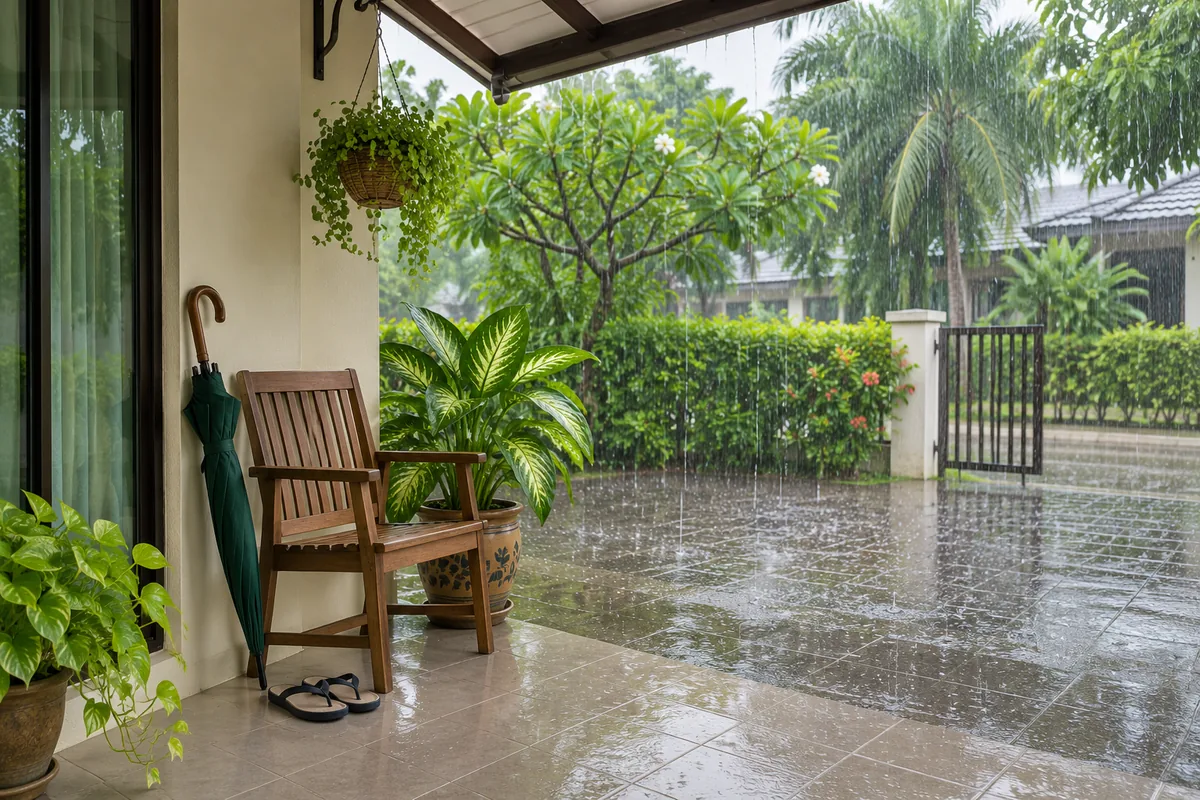
Roughly December to March
Cooler and drier
A relatively drier part of the year, while daytime heat and warm nights continue. The station’s lowest rainfall average is February, not a guarantee of dry weather.
- · Plan shade and hydration even in the drier months
- · Time strenuous activity around heat and your own health needs
- · Cooling demand depends on the home, use and equipment
- · Busy visitor periods can change traffic and availability; check your actual dates
Heat builds through February to April
Hot
March has the highest average daily maximum in the Phuket station series, 34.4°C; April has a slightly higher overall mean.
- · Avoid treating the daily average as the hottest temperature possible
- · Cooling and ventilation change comfort and bills
- · Test afternoon sun in the intended living and work rooms
- · Showers increase as the year moves towards the southwest monsoon
Roughly May to October, peaking September and October
Wetter and monsoon-influenced
The southwest monsoon brings substantially more rain to the Andaman coast. Wet periods may include prolonged rain and rough seas as well as showers.
- · September and October are the wettest months on long-term averages
- · Humidity peaks — mould, damp storage and slow-drying laundry become real household issues
- · Slightly lower daytime temperatures do not remove humid heat or warm nights
- · Drainage, plot elevation and roof condition show their true colours
Which months are best for you?
There is no single best time to be here. It depends on what you want the weather to do for you.
Outdoor life generally
December to February
Generally less rain than during the southwest monsoon, while daytime heat remains. Use shade, sensible timing and current warnings.
Golf
Drier months, with a weather check on every date
Choose the tee time around heat and current conditions. Rain, lightning and course conditions can change a booking in any season.
Beach and swimming
December to April
Use current beach flags, lifeguard advice and marine warnings. A season associated with calmer conditions does not guarantee safe swimming.
If you dislike extreme heat
Test your comfort before committing
Phuket remains warm throughout the year; mean daily highs in this station series range from 31.8°C to 34.4°C. Humidity, shade and the home’s ventilation matter.
Quiet season
June to September
Visitor activity and prices vary by area and date. The practical trade-off is a wetter routine and possible sea restrictions; obtain actual quotes rather than assuming a fixed discount.
House-hunting
See a shortlist in both September or October and in the dry season
The wet months expose drainage, damp and noise from rain on roofs. The dry months show you the light, the heat load and how a west-facing terrace really behaves.
The move itself
A drier period can simplify arrival
Weather is one factor beside school, work, housing and immigration dates. Protect belongings from rain and allow flexibility for deliveries and setup.
Air quality: how much should you worry?
Phuket is generally better placed than Thailand's northern and urban hotspots, but “coastal” does not mean “clean all year”.
Thailand's PM2.5 problem is strongly seasonal and strongly regional. The worst of it sits in the north — Chiang Mai and the upper provinces — during the burning season, typically February to April, and in Bangkok during still winter conditions when traffic emissions have nowhere to go. Phuket has neither the large-scale upland burning nor the urban density, and the sea breeze helps.
Local traffic, burning, construction and regional haze can still affect air quality. This climate page does not establish a month-by-month air-quality average for Phuket. Use a relevant live monitoring station and current advice, especially if someone in the household is sensitive to poor air quality, rather than treating an island address as a guarantee.
Check current air quality
Air4Thai is the Pollution Control Department's official monitoring network, with station locations shown on its map. Select a relevant Phuket station and check the reading time and pollutant; live readings are separate from the long-term climate figures on this page.
Open Air4ThaiFlooding: what residents should actually check
Check both the property and the routes you depend on; heavy rain can affect more than one street.
Heavy rain can overwhelm drainage, flood low-lying roads and affect access to homes, schools and hospitals. A house that stays dry can still be difficult to reach. Conditions differ between plots, hillsides and roads, so inspect drainage, ask about previous incidents and consider the routes your household will actually rely on.
That makes it a due-diligence issue, but no viewing or reassuring answer removes the risk. Review the property's history, current maintenance and alternative access routes before signing, then follow warnings during heavy rain.
Before renting or buying
- Ask the agent and the neighbours whether the street has flooded before
- Compare the plot level with the road and the surrounding land
- Look at where water leaves the garden, not just where it arrives
- Check ceilings, skirting boards and wardrobe backs for water marks or fresh paint
- Look at roof drainage, gutters and downpipes rather than only the roof itself
- If you can, walk the neighbourhood within a day of heavy rain
Your house experiences the climate tooThe building decisions that matter here are not the ones that matter in a temperate country.
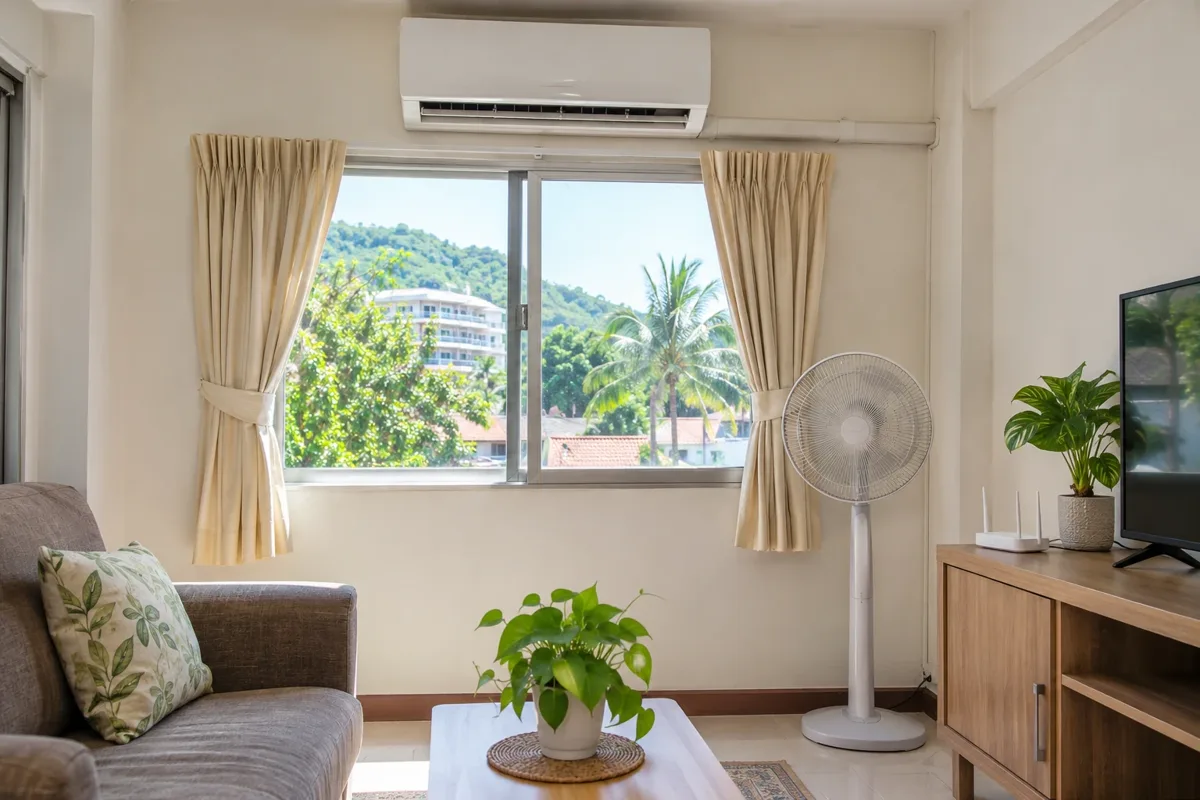
Air-conditioning and zoning
Cooling the rooms you use, rather than the whole house, is the single biggest lever on running costs. Inverter units, closed doors and clean filters all help. Servicing matters more here than the manuals suggest.
Orientation and shade
West-facing glass turns a living room into an oven by four o'clock. Roof overhangs, mature trees and a shaded terrace change how usable a property is from March to May. View a house at the hour you would actually be in it.
Ventilation and moisture
Cross-ventilation, bathroom extraction and airflow behind wardrobes prevent most damp problems. A condo with one aspect and sealed windows needs more active management than an airy house.
Outdoors and coastal exposure
Pools, gardens and outdoor furniture all need year-round attention, and salt air close to the sea is hard on metal fittings, air-conditioning units and hinges. Budget for maintenance rather than treating it as an occasional surprise.
The climate changes when you do thingsPlan outdoor routines around heat, rain and current warnings. Some beach, hiking and boat plans need to wait.
Even in the drier months, midday heat can make sport demanding. Early starts, shade and a flexible schedule help with golf, running and cycling. In the wet months, check forecasts, lightning risk and route conditions as well as the temperature; a flooded road or slippery trail can change the activity itself, not only the starting time.
A wetter month does not remove every opportunity to be outdoors. It does require alternatives and a willingness to cancel when conditions are unsafe. Sea warnings and beach flags take priority over a planned outing.
Climate with children
School runs land at two of the hotter parts of the day, so an air-conditioned car and window shades stop being a luxury. Sport moves to early morning or late afternoon; pools carry much of the load in April and May. Sun protection becomes a daily routine rather than a beach-day one, and families quickly build a mental list of indoor options for the wet-season afternoons when the sky closes in.
What do people actually wear?
Everyday clothing here is chosen for heat, humidity and strongly air-conditioned interiors, in that order: lightweight breathable fabrics, sandals or shoes that cope with a sudden downpour, a hat, and a light layer for restaurants and cinemas that treat 21°C as a target. A compact umbrella and a light rain layer earn their space from May onwards. Almost everything else can be bought locally.
How Phuket's climate comparesThailand does not have one climate. If you are choosing between places, the differences are larger than the map suggests.
| Place | Heat | Rainfall pattern | Humidity | Worth knowing |
|---|---|---|---|---|
| Hua Hin | Hot, peaking April | A different Gulf-coast pattern; consult local normals | High, peaking in the wet months | Sheltered west-coast Gulf position, steady sea breeze, short dry-season haze episodes |
| Bangkok | Hotter, less coastal relief | Urban mainland wet season; consult local normals | High year-round | Urban heat and traffic pollution; no sea breeze to soften afternoons |
| Chiang Mai | Cooler nights in winter, very hot April | Concentrated May–September | Lower in the cool season | Well-documented burning-season air quality problems, typically February–April |
| Phuket | Steady, less seasonal variation | Phuket station: about 2,272 mm; wettest September–October | High year-round | Andaman coast, exposed to the southwest monsoon and heavier swell |
| Koh Samui | Steady year-round | Different rhythm — wettest around November–December | High year-round | Gulf island; do not apply Phuket’s Andaman seasonal pattern directly |
Qualitative comparison based on published national climate statistics. We do not score destinations against each other.
Climate myths worth forgetting
“Rainy season means it rains all day”
The Phuket station records about 22–23 rainy days in September and October, counted at 0.1 mm or more. That does not mean rain all day, but it also does not promise only a brief afternoon shower.
“Thailand is equally hot all year”
Average daily highs range from 31.8°C to 34.4°C in the Phuket station normals. Humidity, sun, wind and indoor cooling change the lived experience beyond that relatively narrow range.
“December is cool”
December is relatively drier, but Phuket station averages a 32.1°C daily high and 25°C low. A seasonal label does not mean cool nights.
“The weather is the same everywhere in Thailand”
Phuket is exposed to the southwest monsoon on the Andaman side. Hua Hin is on the Gulf coast, while Koh Samui has a different wet-season emphasis. Use local station data and forecasts.
“Average temperature tells you how comfortable it will feel”
Humidity, direct sun, shade and wind change perceived comfort more than a degree or two on the thermometer.
What the climate means if you are moving to PhuketSix conclusions that follow from everything above.
You will reorganise your day
Most long-term residents end up doing anything strenuous before ten and after five. Nobody decides this deliberately; it happens within the first hot season.
Shade matters more than newcomers expect
A shaded terrace, a roof overhang or mature trees change a property more than an extra bedroom does. Orientation is worth checking at the time of day you would actually use the space.
The cheapest house to rent is not always the cheapest to live in
High ceilings, single glazing, west-facing glass and a large pool all add to the monthly running cost. Ask about typical electricity bills before signing.
Drainage belongs on your viewing checklist
Plot elevation, gutters and where water leaves the garden are easy to check and expensive to ignore.
Humidity is a household issue, not just a weather statistic
Ventilation, occasional air-conditioning and open wardrobes prevent most of the mould problems people complain about.
Weather can change the plan as well as the timing
Marine warnings, lightning and unsafe access can require cancellation or a different activity. Keep useful indoor and transport alternatives instead of relying on a short gap between showers.
So, is Phuket's climate comfortable?
That depends largely on your tolerance for tropical heat. Phuket never becomes cool in the European sense, April genuinely takes some adjustment, and the wet months ask more of your house than most people expect. Suitable housing, a realistic wet-season routine and the ability to shift outdoor life towards mornings and evenings make it workable for a great many long-term residents.
The biggest adjustment is usually not learning to live with bad weather. It is learning to organise ordinary life around tropical weather. Give yourself time to experience both hot and wet periods before judging the fit.
Climate is not today's weather
Everything on this page describes long-term averages over 1991–2020. Individual years vary: unusually wet Octobers, dry Septembers and hot Februaries all happen. Climate normals are a baseline for planning, not a forecast, and they should never be read as a prediction of the week you happen to arrive.
Averages also shift. These figures describe a past 30-year baseline, not a promise about future conditions or extreme events. Use current forecasts and official warnings for decisions today; a new published normal period will require a fresh review of the charts and practical guidance.
Data and sources
Thai Meteorological Department — 1991–2020 climatological data
Thai Meteorological Department — Phuket forecast
Thai Government — monsoon seasons
Air4Thai — Pollution Control Department
Sources reviewed
Sources reviewed
November 2026
Next scheduled review
November 2027
Sources checked
- · Thai Meteorological Department — 1991–2020 climatological data
- · Thai Meteorological Department — Phuket forecast
- · Thai Government — monsoon seasons
- · Air4Thai — Pollution Control Department
Climate normal period: 1991–2020. Where a metric could not be sourced reliably for Phuket — monthly sea temperature and sunshine hours among them — we describe it qualitatively rather than publishing a number.
Common questions
What is the best time of year to be in Phuket?
For drier conditions, January and February are the clearest starting point; December usually marks a transition towards the drier period. It stays hot all year. The wetter months can suit a flexible routine, but sea conditions, rain and the actual neighbourhood matter more than a universal best-month label.
Does Phuket have a rainy season?
Yes. The Phuket station normals show a wet stretch from May through October, with September and October the highest-rainfall months. November remains wet. Annual rainfall is about 2,272 mm; a rainy-day count includes any day with at least 0.1 mm, not necessarily a whole day lost to rain.
How hot does Phuket get?
Average daily highs stay around 32–34°C across the year. March has the highest mean maximum in these normals, while April has the warmest mean nights. Humidity, shade and ventilation change how those figures feel; December still has average highs above 32°C.
Is Phuket's climate the same as Hua Hin's?
No. Phuket is on the Andaman side and is exposed to the southwest monsoon. Hua Hin is on the Gulf coast with a different rainfall pattern. Koh Samui also has a different seasonal peak; do not transfer the best-month advice from one coast to another.
Is mould a problem in Phuket homes?
It can be, particularly in the wet months. Monthly mean humidity reaches the low eighties in the station normals. Moisture control, ventilation and suitable use of air-conditioning help, but existing leaks or damp need investigation. Check bathrooms, wardrobe backs and skirting before signing a lease.
Where to go next
Explore everyday life
Choose where to live
Understand your budget
Planning the move?